
You wake up at 2 a.m., heart pounding, because your teeth just fell out — again. Good news: you are not uniquely cursed. According to researcher Michael Schredl's frequency studies on "typical dreams," falling, being chased, and teeth-loss are among the most commonly reported dream themes across populations. You're basically dreaming in unison with the rest of humanity. Cozy, right?
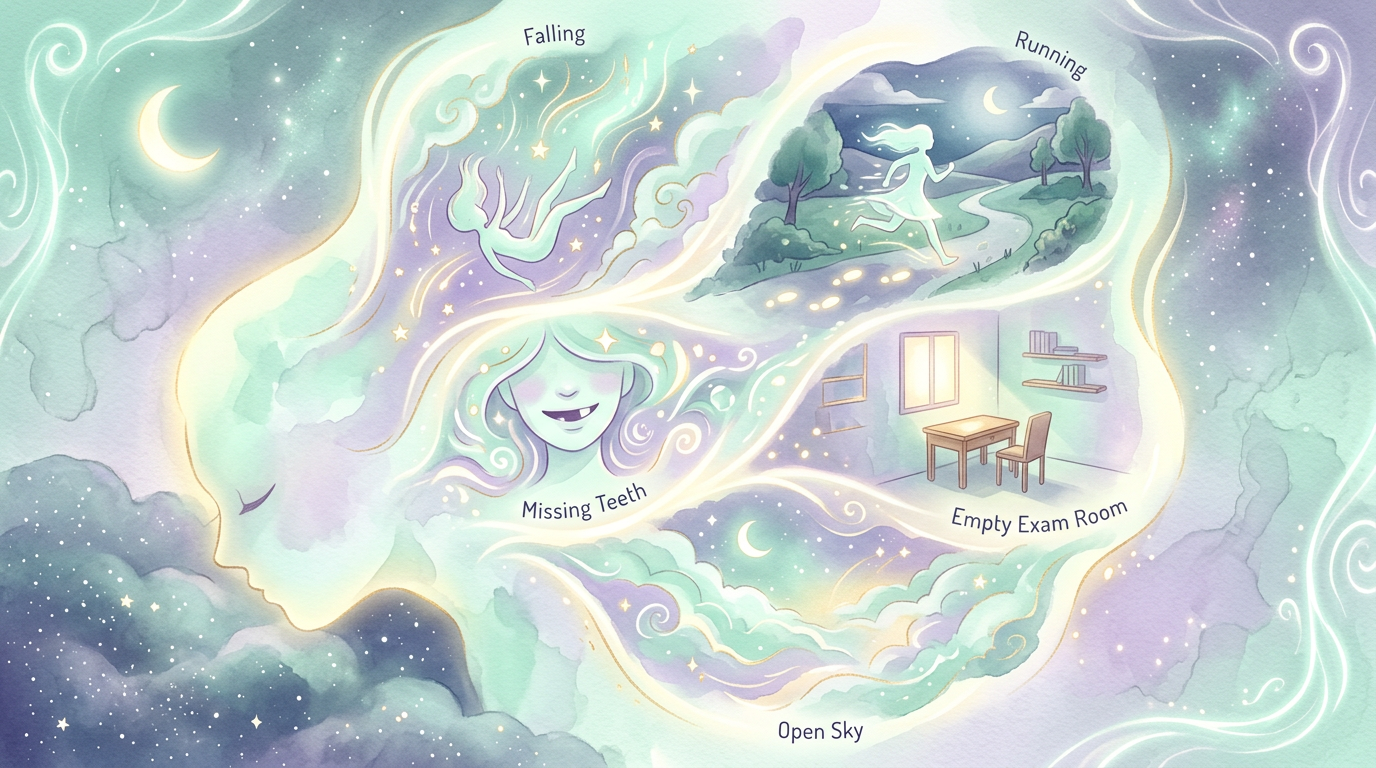
Here are the five dream scenarios that real sleep research keeps finding at the top of the list — plus a wildly confident ancient opinion on each one, just for fun.
1. Falling — the classic
You're somewhere high, then suddenly you're not, and you jolt awake before you hit the ground. Michael Schredl's research places falling consistently among the most frequently reported dream themes across populations. It's so common it's almost a cliché — except it keeps happening to you personally, which makes it feel very not-cliché.
For historical color: Artemidorus of Daldis, writing his dream manual Oneirocritica in the 2nd century CE, had interpretations ready for falling dreams — though those readings are folklore, not science, and are best enjoyed as a window into how seriously ancient cultures took their sleep lives.
2. Being chased — run, but make it REM
Something is behind you. You can't quite see it. Your legs are moving in slow motion. Michael Schredl's frequency studies identify being chased as one of the top recurring dream themes reported across different groups of dreamers. The pursuer changes — a person, a creature, a vague threat — but the chase stays the same.
Artemidorus also had thoughts on pursuit dreams in Oneirocritica, as ancient dream interpreters tended to have thoughts on everything. Again: historical curiosity, not a verdict on your waking life.
3. Teeth falling out — everyone's least favorite
You're mid-conversation and suddenly your teeth are just... leaving. Michael Schredl's research specifically names teeth-loss among the most commonly reported dream themes across populations. Knowing that doesn't make the dream less unsettling, but it does make it feel less like a personal omen and more like a shared human experience.
Artemidorus devoted attention to teeth dreams in Oneirocritica — the oldest surviving dream manual — offering interpretations that varied depending on which teeth and what happened to them. Fascinating as history; not a diagnosis.
4. Showing up unprepared — the exam you forgot to study for
You're in a room, there's a test, and you have not attended a single class. Or it's a performance and you don't know the lines. Calvin S. Hall and Robert Van de Castle's foundational work, The Content Analysis of Dreams (1966), established a rigorous coding system for dream content and documented base-rate frequencies of common dream scenarios — and unpreparedness themes show up in that record of what people actually dream about.
The specifics shift — exam, audition, big meeting — but the core anxiety is remarkably consistent across dreamers.

5. Flying — the good one
Finally, the dream everyone actually wants to have. Flying appears in the documented base-rate frequencies of common dream elements that Hall and Van de Castle catalogued in The Content Analysis of Dreams. Sometimes it's effortless; sometimes you have to concentrate hard to stay airborne. Either way, it's the one dream people are genuinely disappointed to wake up from.
Artemidorus, predictably, had interpretations for flying dreams in Oneirocritica too — ancient dream culture was thorough. But as with all the entries here, those readings are offered as cultural heritage and historical reflection, not as predictions about your actual life.
So… what does it all mean?
Honestly? The research tells us these dreams are common — that's the finding. Hall and Van de Castle built the field's standard coding system precisely to measure what people dream about at a population level, and Schredl's frequency studies confirmed which themes keep rising to the top. The "why" is still genuinely debated. What the data does settle is that you are not alone in your falling, fleeing, toothless, underprepared, occasionally airborne dream life. That's something.
- Calvin S. Hall & Robert Van de Castle, The Content Analysis of Dreams (Appleton-Century-Crofts, 1966) — foundational coding system and base-rate frequency documentation for common dream content.
- Michael Schredl, research on "typical dreams" — frequency studies placing falling, being chased, and teeth-loss among the most commonly reported dream themes across populations.
- Artemidorus of Daldis, Oneirocritica (2nd century CE) — the oldest surviving dream manual, cited here as historical and cultural counterpoint, not as factual guidance.
This article is offered for cultural reflection and entertainment only, not as psychological advice or prediction of any kind.
Lunaple's dream journal prompts and symbol guides are designed for exactly this kind of 2 a.m. curiosity — explore them at your own pace.
Explore Dream GuidesFor entertainment purposes only. Not a substitute for professional, medical, legal, or financial advice.
← Back to the Journal