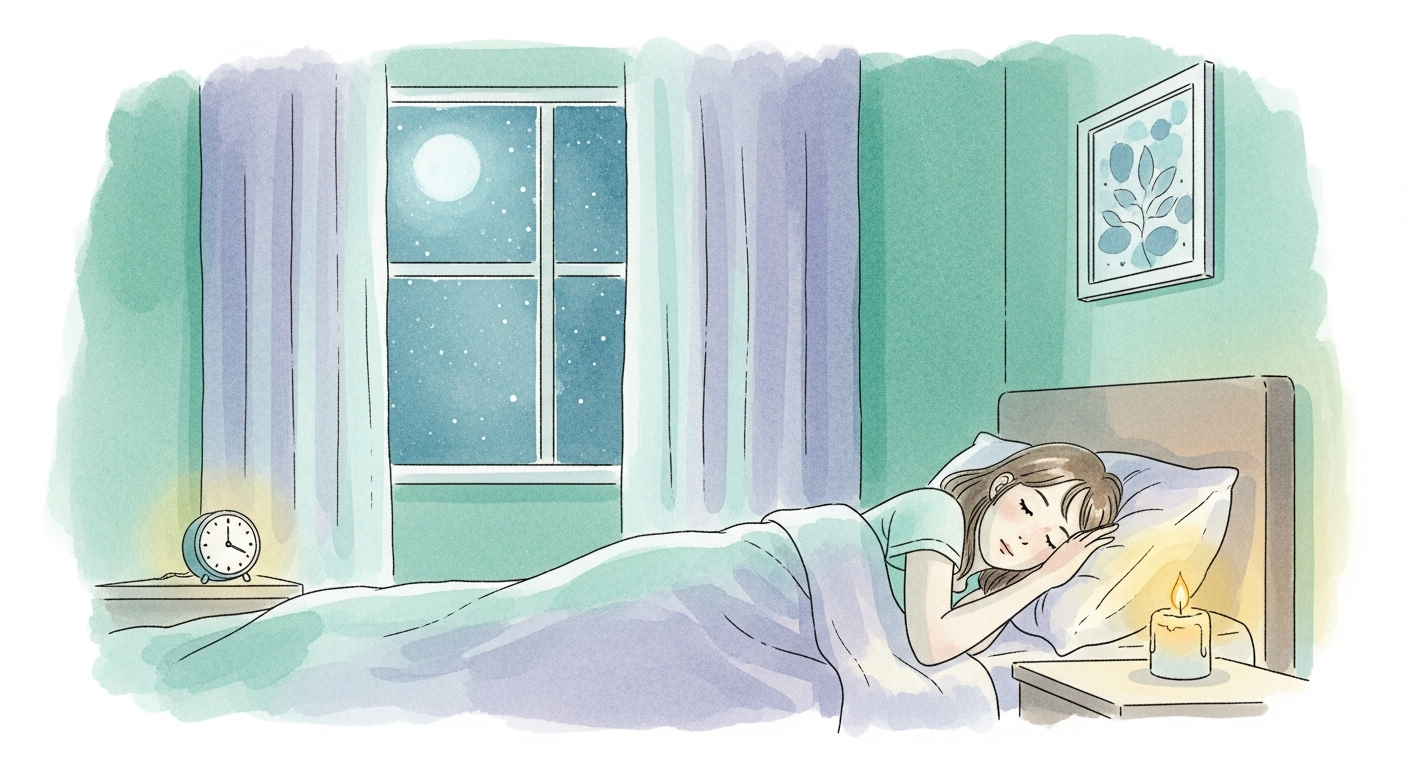
It's almost always the same time, isn't it? Not 2:14, not 4:47 — but somewhere right around 3 AM. Your eyes snap open in the dark, your heart is doing a little drumroll, the house is dead quiet, and there's no reason for any of it. You weren't dreaming. Nothing woke you. You just… surfaced. And then you lie there feeling weirdly watched, wondering why this keeps happening to you.
Here's the comforting part: it's happening to basically everyone. And humans have been spooked by this exact hour for centuries — long before anyone could measure what was going on inside our sleeping brains. So let's do both halves: the eerie old story first, then what's actually happening under the covers.
The hour people have feared for centuries
In Western folklore, the small hours got a sinister nickname: the witching hour, sometimes called the devil's hour. The phrase itself is old and literary — Shakespeare gives us "the very witching time of night" in Hamlet, and the wording "witching hour" shows up in print by 1762, in Elizabeth Carolina Keene's Miscellaneous Poems. The idea was simple and unsettling: this was the stretch of night when the veil felt thinnest and supernatural forces were thought to be at their strongest.
So why 3 AM specifically, and not midnight? According to references like the Encyclopaedia Britannica and the documented folklore tradition, the 3 AM "devil's hour" is often explained as a mocking inversion of 3 PM — the time at which Christ was traditionally said to have died. Flip the sacred hour upside down, the thinking went, and you get its dark mirror. It's a genuinely creepy bit of symbolic logic, and you can see why it stuck around in ghost stories and late-night lore. It's also, to be clear, folklore — a cultural story we've told ourselves, not a measurement of anything.
What your body is actually doing at 3 AM
Now the part that I find weirdly reassuring. Your sleep isn't one long flat tunnel — it's built in cycles. As sleep scientist Matthew Walker explains in Why We Sleep, your brain moves through roughly 90-minute cycles all night long, alternating between deep NREM sleep and dream-rich REM sleep. And the mix shifts as the night goes on: the early hours are dominated by heavy, hard-to-wake deep sleep, while the second half of the night — the small hours — loads up on lighter, REM-heavy sleep. In other words, by around 3 AM you're naturally floating in shallower water. It takes much less to tip you awake.
Then there's the hormone half of the story. Your body runs on a daily cortisol rhythm — cortisol being the "get up and go" hormone. Research on the cortisol awakening response, established by scientists including Angela Clow and Frank Hucklebridge, shows that cortisol bottoms out in the early part of the night and then begins quietly climbing in the late part of your sleep, before you ever open your eyes. So in the pre-dawn hours, two things line up: you're already in your lightest, most wakeable sleep, and your stress-alertness hormone is on its way up. Add a stressful week — when cortisol tends to run higher — and that gentle nudge toward waking becomes a full sit-up-in-bed jolt.
That's the "perfect storm" behind the 3 AM wake-up: lighter sleep architecture meeting a rising hormonal tide. No veil, no visitor. Just biology doing exactly what it's scheduled to do.
So the next time you blink awake at that uncanny hour, you get to hold both truths at once. There's the old story — centuries of people feeling the same shiver and naming it the witching hour. And there's the quiet science — your brain in light sleep, your cortisol on the rise, your body keeping perfect time. Honestly? Knowing both makes 3 AM feel a little less lonely. You're not being haunted. You're just awake in the company of everyone who's ever been awake at 3 AM before you.
If something pulled you out of sleep, let Luna help you make sense of what your mind was replaying.
Interpret a DreamFor entertainment purposes only. Not a substitute for professional, medical, legal, or financial advice.
← Back to the Journal