
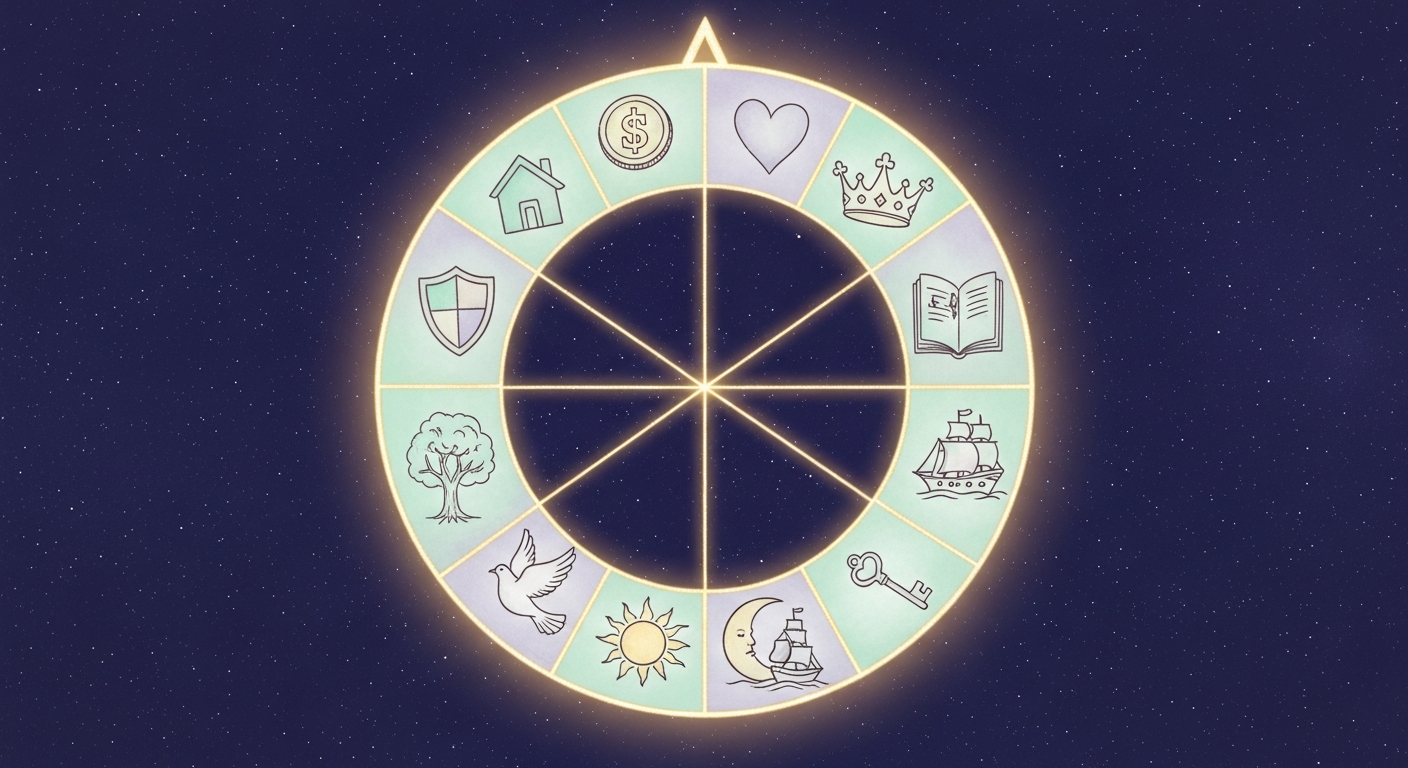
Think of your birth chart as a clock face divided into twelve slices. Each slice is a house — a specific area of life. The planets land wherever they land, but the houses tell you where that energy plays out. According to the early Hellenistic astrologer Vettius Valens in his Anthologiae (2nd century CE), the twelve places each carry distinct life-topics, from the body you were born into all the way to hidden matters and self-undoing. Here's the whole wheel, no jargon required.
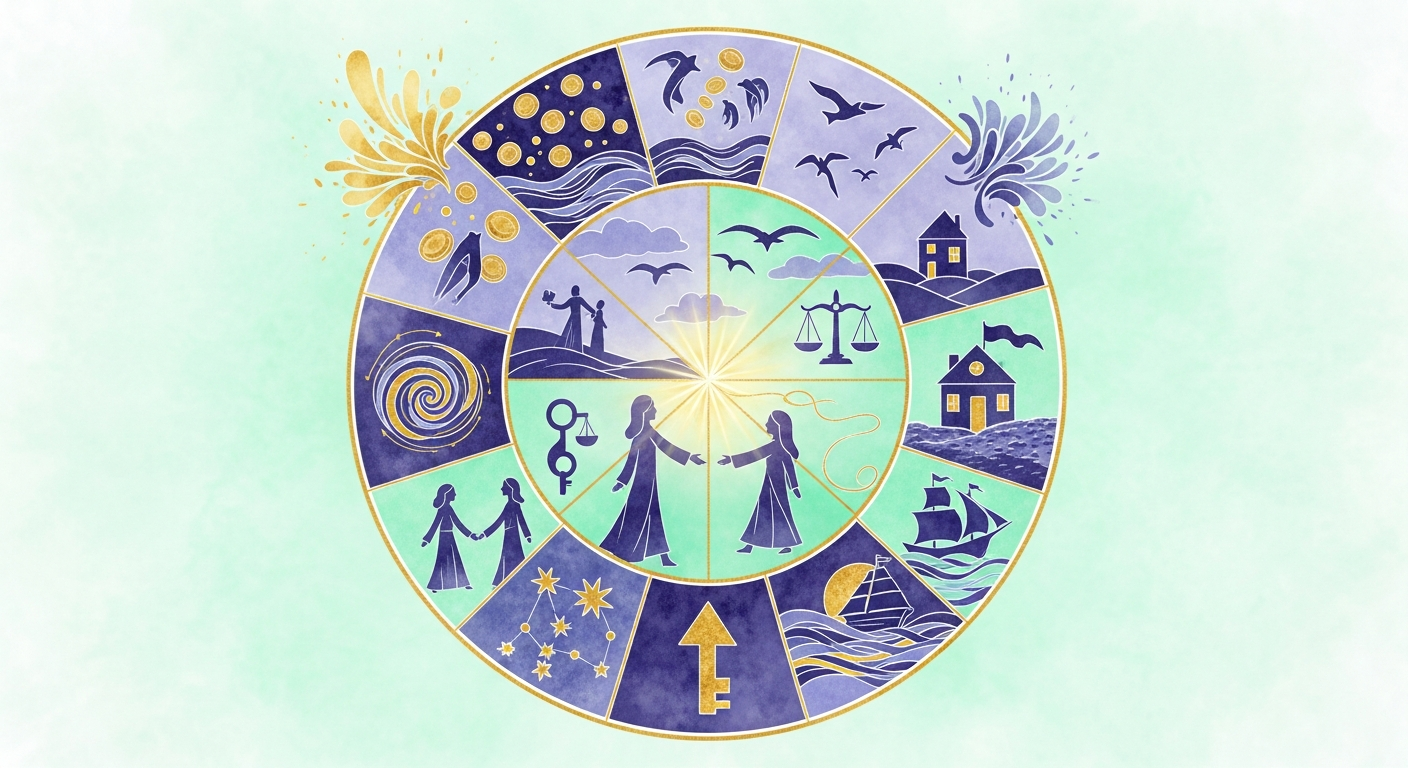
Houses 1–4: You, Your Stuff, Your People, Your Roots
- 1st House — The Body & Self. Valens describes the first place as connected to the native's body and life itself. It's the starting point: how you show up, literally and energetically.
- 2nd House — Resources & Livelihood. In the Anthologiae, Valens associates this place with livelihood and material resources — basically, how you earn and what you own.
- 3rd House — Siblings, Short Journeys & Community. Valens links this place to siblings and local connections. Think: the people and places close to home.
- 4th House — Parents, Home & Origins. Ptolemy's Tetrabiblos (2nd century CE) treats the fourth angle as foundational to questions of parents and home. It's your roots — literal and ancestral.
Houses 5–8: Pleasure, Service, Partnership & Transformation
- 5th House — Children & Pleasure. Valens records the fifth place as connected to children and good fortune — the zone of joy, creativity, and play.
- 6th House — Illness & Service. Both Valens and Ptolemy treat the sixth as a place of bodily challenges and service to others. Not the glamorous house, but an important one.
- 7th House — Partnership. Ptolemy identifies the seventh angle (the Descendant) as the place of marriage and significant partnerships. The axis directly opposite your rising sign — the mirror of the self.
- 8th House — Death & Inheritance. Valens describes the eighth place in connection with death and matters that follow it, including inheritance. Heavy, yes — but also about profound transformation and shared resources.
Houses 9–12: Big Ideas, Career, Community & the Hidden
- 9th House — Travel, Philosophy & the Divine. Valens associates the ninth place with long journeys, foreign matters, and the divine — the house of big-picture thinking and spiritual seeking.
- 10th House — Career & Public Life. Ptolemy treats the tenth angle (the Midheaven) as the place of action and public reputation. This is the house everyone asks about first.
- 11th House — Friends, Hopes & Good Fortune. Valens calls the eleventh place the "house of the Good Daimon," linking it to friends, allies, and hopes. Your squad and your dreams, in one house.
- 12th House — Hidden Matters & Self-Undoing. Valens describes the twelfth as connected to hidden enemies, confinement, and things that work against the native — the shadow side of the chart, and a place for deep inner work.

So… Why Does Any of This Matter?
The houses aren't predictions — they're a map. As both Ptolemy's Tetrabiblos and Valens's Anthologiae show, this framework has been used for nearly two thousand years as a way to organize questions about human experience: body, money, relationships, purpose, loss, hope. Whether you treat it as literal guidance or as a reflective tool for thinking about your own life, the twelve houses give you a surprisingly complete vocabulary for the things we all actually care about. Which house are you most curious about? (Asking for a friend. The friend is us.)
- Ptolemy, Tetrabiblos, 2nd century CE. A foundational text of the Western house and angle system.
- Vettius Valens, Anthologiae, 2nd century CE. An early Hellenistic astrologer's working account of the twelve places (houses) and their life-topics.
This article is offered for cultural reflection and historical interest, not as prediction or personal advice.
Your birth chart shows exactly which areas of life are most activated for you right now. Lunaple can walk you through it in plain English.
Explore My ChartFor entertainment purposes only. Not a substitute for professional, medical, legal, or financial advice.
← Back to the Journal